Northern Snakehead vs Bowfin: How to Tell Them Apart
Learn how to tell the difference between a northern snakehead and a bowfin. Identification tips, key physical features, and why it matters for anglers.
Two Fish That Fool Almost Everyone
If you fish anywhere in the eastern United States, you've probably seen the confusion firsthand. Someone posts a photo of a long, toothy, snake-looking fish and the comments erupt — "that's a snakehead, kill it" or "that's just a bowfin, put it back." Half the time, the people arguing are wrong.
Northern snakeheads and bowfin look remarkably similar at first glance. Both are dark, elongated predators with long dorsal fins and big mouths full of teeth. But they're completely different fish with very different implications for the waters they live in. Knowing which one you're holding matters — in some states, releasing a snakehead is illegal.
Why It Matters
The bowfin is a native North American species. It's been here for over 100 million years and plays a natural role in its ecosystem. It's a living fossil — the last surviving member of an ancient fish family that predates the dinosaurs.
The northern snakehead is an invasive species originally from Asia. It was first confirmed in U.S. waters in 2002 in a Maryland pond, and it has since spread through the Potomac River watershed and into multiple states. Snakeheads compete with native fish for food and habitat, and they can breathe air, allowing them to survive in conditions that would kill most other fish.
In states like Virginia, Maryland, and Pennsylvania, you are required to kill any northern snakehead you catch. You cannot release it alive. Mistaking a bowfin for a snakehead — or the other way around — can mean breaking the law or needlessly killing a native species.
Head Shape
This is the single most reliable difference and the first thing to check.
Bowfin have a short, rounded head. The snout is blunt and the head transitions smoothly into the body. If you look from above, the head looks almost tubular.
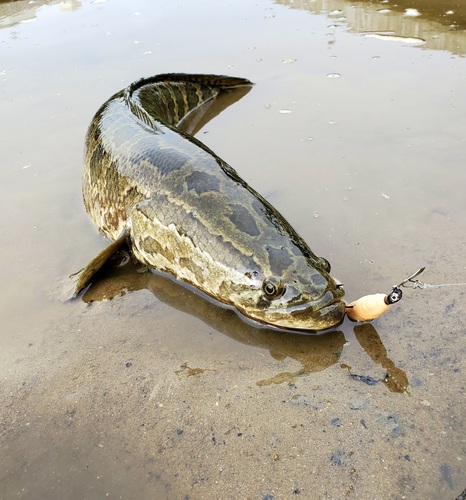
Northern snakeheads have a long, flattened head that's distinctly wider than the neck. It looks like a snake's head — flat on top with a clear taper behind the eyes. The name isn't just for show. If you look down at a snakehead from above, the head is noticeably broader and flatter than a bowfin's.
If you remember one thing from this article, make it this: flat, wide, snake-like head means snakehead. Round, blunt head means bowfin.
Anal Fin
The anal fin — the fin on the underside of the fish between the belly and the tail — is the second easiest identifier.
Bowfin have a short anal fin. It's compact and doesn't extend far along the body.
Northern snakeheads have a long anal fin that runs a significant portion of the body's underside, roughly mirroring the length of the dorsal fin above it.
If the anal fin is long, it's a snakehead. Short anal fin, it's a bowfin.
Dorsal Fin
Both fish have long dorsal fins that run along most of their backs, which is a big reason they're confused in the first place.
Bowfin dorsal fins are wavy and undulating — the fin has a soft, rippling appearance without distinct separations.
Northern snakeheads have a dorsal fin that looks similar in length but is often held more rigidly and may appear slightly different in texture. The dorsal fin alone isn't the best identifier, but combined with the anal fin length, it confirms the ID.
Color and Pattern
Both fish are dark and mottled, but the patterns differ.
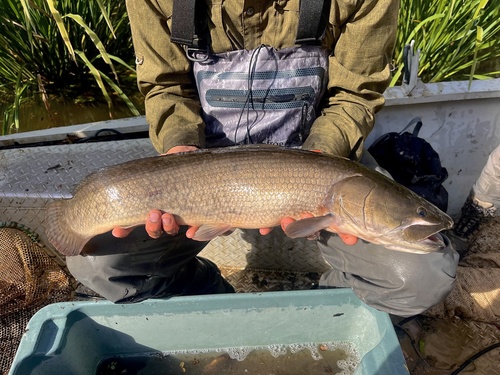
Bowfin are typically olive-green to brown with darker mottled markings that can appear somewhat random. Males often have a distinctive black spot ringed with orange or yellow at the base of the tail fin. This ocellus, or eyespot, is a strong bowfin indicator — snakeheads don't have it.
Northern snakeheads tend to have a more defined pattern of dark blotches along the sides, often appearing as irregular saddle-like markings. Their coloring can range from dark brown to almost black with tan or lighter patches between the blotches
Pelvic Fins
This is a subtle but definitive difference.
Bowfin have pelvic fins positioned far back on the belly, roughly in the middle of the body.
Northern snakeheads have pelvic fins positioned far forward, very close to the pectoral fins and head.
If the pelvic fins are up near the front of the fish, it's a snakehead.
Scales
If you can get a close look at the scales, there's a clear difference.
Bowfin have smooth cycloid scales that feel relatively slick.
Northern snakeheads have ctenoid scales that feel rough to the touch, more like a bass or perch.
Quick Reference
| Feature | Bowfin | Northern Snakehead |
|---|---|---|
| Head shape | Short, rounded | Long, flat, snake-like |
| Anal fin | Short | Long |
| Pelvic fin position | Mid-body | Near head |
| Scale texture | Smooth | Rough |
| Native status | Native | Invasive |
Habitat and Range
Bowfin are found throughout the eastern United States and into southern Canada. They prefer slow-moving, heavily vegetated waters — swamps, backwaters, oxbow lakes, and sluggish rivers. They've been here since before humans arrived on the continent.
Northern snakeheads have been expanding their range since their introduction. They're now established in the Potomac River and its tributaries, parts of the Delaware River, the lower Susquehanna, and scattered locations from New York to Arkansas. They also prefer slow, vegetated water, which puts them in direct competition with bowfin and other native species in overlapping ranges.
What to Do If You Catch One
If it's a bowfin: You've caught a remarkable fish. Bowfin fight incredibly hard for their size and are increasingly appreciated by anglers. Check your state regulations — in most places, you can release bowfin. Handle it carefully and get it back in the water.
If it's a northern snakehead: Check your state regulations immediately. In most states where snakeheads are present, you are required to kill it and report the catch to your state wildlife agency. Do not release it. Many states have specific reporting hotlines or online forms for snakehead catches.
If you're not 100% sure which fish you have, take clear photos from multiple angles — especially the head from above, the anal fin, and the full body profile. Your state fish and wildlife agency can help with identification, and apps like CatchVault use AI species identification to help you confirm what you've caught on the spot.
Respect the Native, Report the Invasive
Bowfin deserve more respect than they get. For years, anglers dismissed them as trash fish, and the confusion with snakeheads has only made that worse. They're a native apex predator with an ancient lineage, and they fight like nothing else in freshwater.
Northern snakeheads are a real ecological concern, but the solution starts with correct identification. Learn the differences, teach other anglers, and always check before you act. The wrong call can either harm a native population or allow an invasive species to keep spreading.
Ready to Fish Smarter?
Download CatchVault free on iOS, log catches, identify species with AI, and measure fish with LiDAR.