Water Type
Freshwater
Also known as
European Carp, Mirror Carp, Leather Carp
IUCN status
VulnerableAbout the Carp
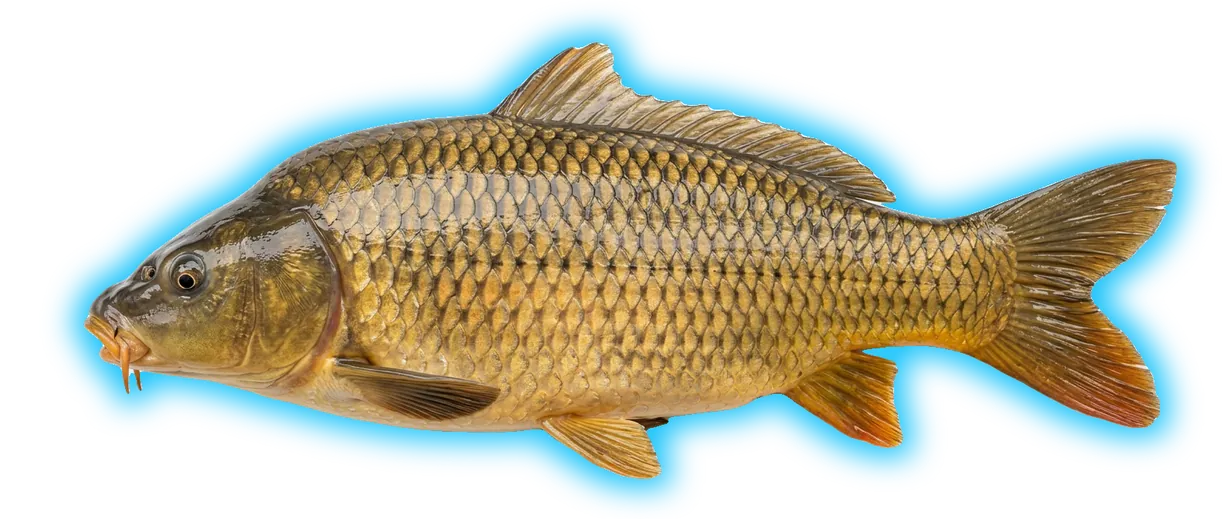
The Common Carp is a large, powerful freshwater fish recognizable by its often golden to olive-brown body and two pairs of distinctive barbels flanking its mouth. While some are fully scaled (Common Carp), many anglers encounter varieties like the Mirror Carp with scattered, large scales or the Leather Carp which is nearly scaleless. Its thick, robust body and large, protractible mouth are perfectly adapted for bottom feeding.
Source: FishBase & iNaturalist
Carp Size & Bag Limits by State
Carp rules in 13 states.
| State | Size limit | Daily bag | Season |
|---|---|---|---|
| ArizonaYear-round | None | No limit | Year-round |
| CaliforniaYear-round | None | No limit | Year-round |
| ConnecticutYear-round | None | 5 | Year-round |
| MarylandYear-round | None | 15 | Year-round |
| MinnesotaYear-round | None | No limit | Year-round |
| MissouriYear-round | None | No limit | Year-round |
| New HampshireYear-round | None | No limit | Year-round |
| New JerseyYear-round | None | 25 | Year-round |
| New YorkYear-round | None | — | Year-round |
| PennsylvaniaYear-round | None | 50 | Year-round |
| South DakotaYear-round | None | No limit | Year-round |
| VermontYear-round | None | No limit | Year-round |
| WisconsinYear-round | None | No limit | Year-round |
— means the state sets no daily bag number for this species.
Statewide rules, or each area where a state sets limits by region. Many lakes and rivers have their own limits; pick a state or open its regulations page for water-specific rules. Always confirm with the state wildlife agency before keeping a fish.
Rules for a specific state
Pick a state to see its Carp rules, including lakes and rivers with their own limits.
Select a state
Always confirm with the official state agency before keeping a fish.
How big do Carp get?
The biggest Carp logged on CatchVault measured 23".
Best bait and lures for Carp
For carp, bait fishing is overwhelmingly effective; tried-and-true baits include canned corn, boilies, bread (doughballs or flakes), and worms, all fished on the bottom. Many anglers prefer a hair rig setup with a method feeder to present bait effectively. Patience and strong tackle are key when targeting these powerful fish.
Is Carp good to eat?
★★★★★
Often described as having a muddy or earthy flavor, particularly if caught from warm, still waters. It can also be quite bony, making careful preparation essential for an enjoyable meal, though it is a valued food fish in some cultures.
Carp habitat
You'll typically find carp in warm, slow-moving or still waters such as lakes, ponds, and large rivers, particularly those with muddy bottoms and abundant aquatic vegetation. They thrive in eutrophic environments, demonstrating a remarkable tolerance for degraded water quality that many other fish cannot endure.
Where Carp are found
Native to Central Europe and Asia, the Common Carp has been widely introduced across the globe due to aquaculture and accidental releases. It is now established on every continent except Antarctica, often becoming an invasive species outside its native range.
Carp behavior
Carp are opportunistic omnivores, primarily feeding on the bottom by grubbing for insects, crustaceans, worms, and plant matter. They are known for their strong, determined fights when hooked, often making powerful runs and dogged dives. While active year-round, their feeding typically slows in colder water, becoming more vigorous during warmer months.
Recent Catches
Biggest Carp
Tips & Tactics
Steelhead vs Rainbow Trout: Same Fish, Different Legal Rules
Steelhead and rainbow trout are the same species. How state laws define steelhead by length and water, the adipose fin rule, and how to tell them apart.
Channel vs Blue vs White vs Flathead Catfish: ID Guide
Tell channel, blue, white and flathead catfish apart by anal fin, tail and jaw, plus hardhead vs gafftop. Why the ID matters for limits and invasives.
Alewife vs Blueback Herring: River Herring & Shad ID Guide
How to tell alewife from blueback herring, and both from American, hickory and gizzard shad, plus why river herring harvest is closed in many states.
Related Species
Where to Catch Carp
States where Carp is found, based on CatchVault's waterbody commonality data.
Think You Can Top the Leaderboard?
CatchVault is available on iPhone and Android. Download the app, log your Carp catch, and see where you rank.