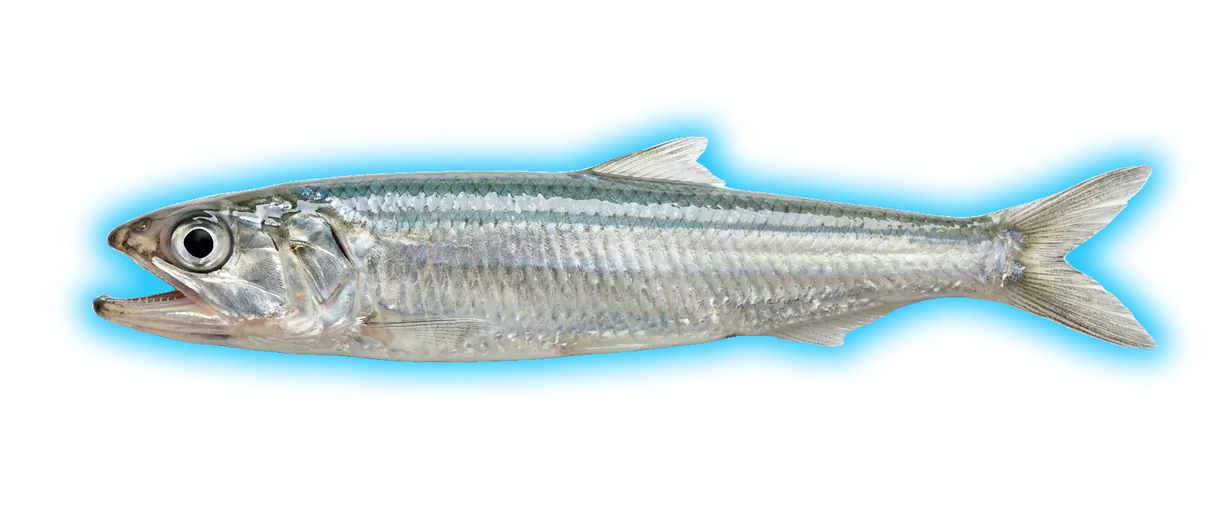
Northern Anchovy
Engraulis mordax
Also known as
null
IUCN status
Least ConcernAbout the Northern Anchovy
These small, silvery, and highly active fish are easily identified by their slender, elongated bodies and a distinctive snout that extends beyond their lower jaw. Their bright, iridescent sides often shimmer with a greenish-blue hue along the back, making them a visible and attractive prey item. Typically ranging from 4 to 9 inches, they form dense schools, resembling shimmering clouds in the water.
Source: FishBase & iNaturalist
Habitat
Northern Anchovies inhabit coastal pelagic waters, preferring the upper layers of the ocean. They are frequently found in bays, estuaries, and nearshore areas where plankton is abundant, often schooling over sandy bottoms or near kelp beds.
Distribution
Their range extends widely across the eastern Pacific Ocean, from the waters off British Columbia, Canada, southwards along the coast of the United States and Mexico, reaching as far as Baja California.
Behaviour
As crucial forage fish, Northern Anchovies are prolific filter feeders, consuming vast quantities of plankton. They exhibit strong schooling behavior, forming massive, tightly packed aggregations that serve as both a defense mechanism and a hunting strategy for larger predators. These schools are highly mobile, often moving in response to food availability, water temperature, and the presence of predatory fish and marine mammals.
Edibility
★★★★★
While small, Northern Anchovies possess a rich, distinctively oily flavor, making them a culinary staple in many regions. They are excellent when pan-fried fresh, pickled, or used to create intensely flavorful sauces and condiments. The strong taste is often preferred by those who enjoy robust seafood flavors.
Lure suggestion
For anglers, Northern Anchovies are primarily prized as live or cut bait, essential for targeting a wide array of predatory species such as Yellowtail, Barracuda, and various rockfish. When using them as live bait, a simple hook-and-leader setup with a small, sharp hook (e.g., size 2-6 octopus or circle hook) is effective, often fished under a float or weighted for depth. Chumming with mashed or cut anchovies is also highly effective to attract game fish. Lures mimicking their appearance, such as small, chrome-plated spoons, jigs, or soft plastics in silver and blue, can also entice strikes from anchovy predators.
Northern Anchovy Regulations
Select a state to see size limits, bag limits, and seasons for Northern Anchovy.
Select a state
Always confirm with the official state agency before keeping a fish.
Biggest Northern Anchovy
No catches logged yet for Northern Anchovy.
Be the first, download CatchVault and log your catch!
Tips & Tactics
Summer Flounder from the New Jersey Surf: A Complete Guide
How to catch summer flounder (fluke) from the New Jersey beach — when and where to go, the best rigs, baits, and retrieves, and the gear that gets it done.
My Review of the Hobie Fleet: What's Best for Saltwater Kayak Fishing
A hands-on review of every Hobie MirageDrive fishing kayak and which model makes the most sense for inshore and open-water saltwater fishing.
How to Jig Giant Plastic Eels for 40"+ Striped Bass
The complete guide to fishing oversized soft plastic eels for trophy striped bass — gear, technique, locations, and timing.
Related Species
Where to Catch Northern Anchovy
States where Northern Anchovy is found, based on CatchVault's waterbody commonality data.
Think You Can Top the Leaderboard?
CatchVault is available on iOS. Download the app, log your Northern Anchovy catch, and see where you rank.