Also known as
three-tooth lamprey, tridentate lamprey
About the Pacific Lamprey
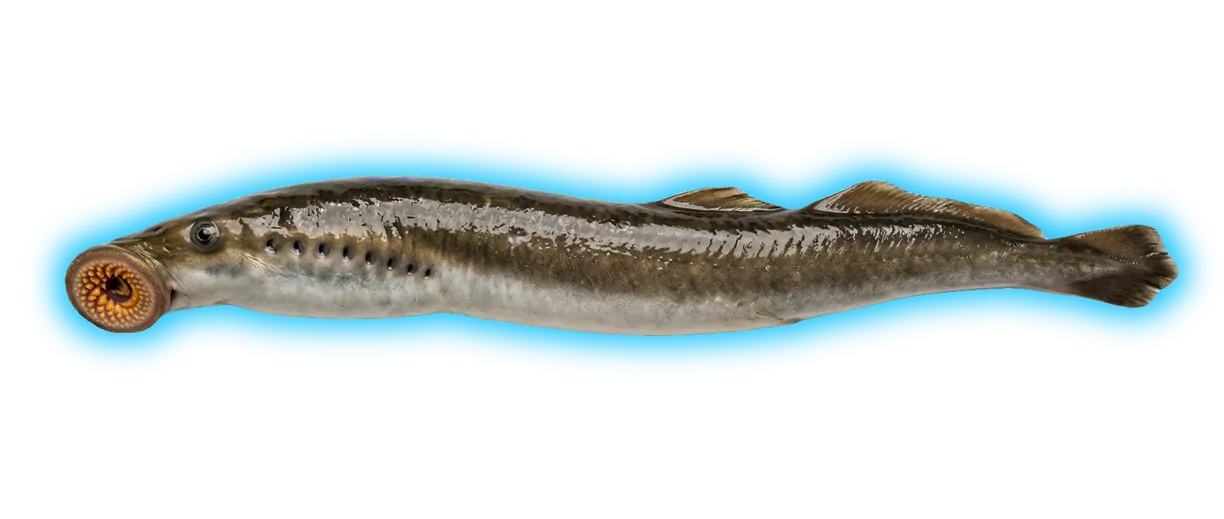
The Pacific Lamprey is an ancient, jawless fish often mistaken for an eel due to its long, cylindrical body. Instead of jaws, it possesses a distinctive suction-cup mouth lined with many small, sharp teeth, which it uses to attach to other fish. Its body coloration can vary, but generally features a dark back transitioning to a lighter belly, providing camouflage in both freshwater and marine environments.
Source: FishBase & iNaturalist
Pacific Lamprey Size & Bag Limits by State
Pacific Lamprey rules in 4 states.
| State | Size limit | Daily bag | Season |
|---|---|---|---|
| CaliforniaYear-round | None | 5 | Year-round |
| IdahoYear-round · Closed | None | 0 | Year-round · Closed |
| OregonYear-round · Year-round closed | None | 0 | Year-round · Year-round closed |
| WashingtonYear-round · Closed | None | 0 | Year-round · Closed |
Statewide rules, or each area where a state sets limits by region. Many lakes and rivers have their own limits; pick a state or open its regulations page for water-specific rules. Always confirm with the state wildlife agency before keeping a fish.
Rules for a specific state
Pick a state to see its Pacific Lamprey rules, including lakes and rivers with their own limits.
Select a state
Always confirm with the official state agency before keeping a fish.
Best bait and lures for Pacific Lamprey
Pacific Lampreys are not a sport fish and are not typically caught with conventional angling methods like lures, baits, or flies. Anglers might occasionally encounter them attached to other fish, but they are not a target species for recreational fishing.
Is Pacific Lamprey good to eat?
While consumed by some indigenous cultures, Pacific Lamprey are not typically targeted for food by recreational anglers due to their unusual appearance and parasitic nature.
Pacific Lamprey habitat
As an anadromous species, the Pacific Lamprey spends its adult life in marine waters, often in coastal areas of the Pacific Ocean. It migrates upstream into freshwater rivers and streams to spawn, requiring clean gravel beds for reproduction and muddy, sandy bottoms for larval development.
Where Pacific Lamprey are found
Found along the Pacific coastlines of North America, ranging from Alaska down to Baja California, and also across to parts of Asia.
Pacific Lamprey behavior
During its ocean phase, the Pacific Lamprey is parasitic, attaching to larger fish and feeding on their blood and bodily fluids. When mature, it undertakes epic upstream migrations in freshwater rivers, often covering significant distances to reach ancestral spawning grounds. Unlike many fish, it does not feed during this freshwater spawning migration, relying solely on stored energy before reproduction and eventual death.
Biggest Pacific Lamprey
No catches logged yet for Pacific Lamprey.
Be the first, download CatchVault and log your catch!
Tips & Tactics
Steelhead vs Rainbow Trout: Same Fish, Different Legal Rules
Steelhead and rainbow trout are the same species. How state laws define steelhead by length and water, the adipose fin rule, and how to tell them apart.
Channel vs Blue vs White vs Flathead Catfish: ID Guide
Tell channel, blue, white and flathead catfish apart by anal fin, tail and jaw, plus hardhead vs gafftop. Why the ID matters for limits and invasives.
Alewife vs Blueback Herring: River Herring & Shad ID Guide
How to tell alewife from blueback herring, and both from American, hickory and gizzard shad, plus why river herring harvest is closed in many states.
Related Species
Think You Can Top the Leaderboard?
CatchVault is available on iPhone and Android. Download the app, log your Pacific Lamprey catch, and see where you rank.