Water Type
Saltwater
Also known as
Saithe, Coalfish, Boston Blue, Coley
IUCN status
Least ConcernAbout the Pollock
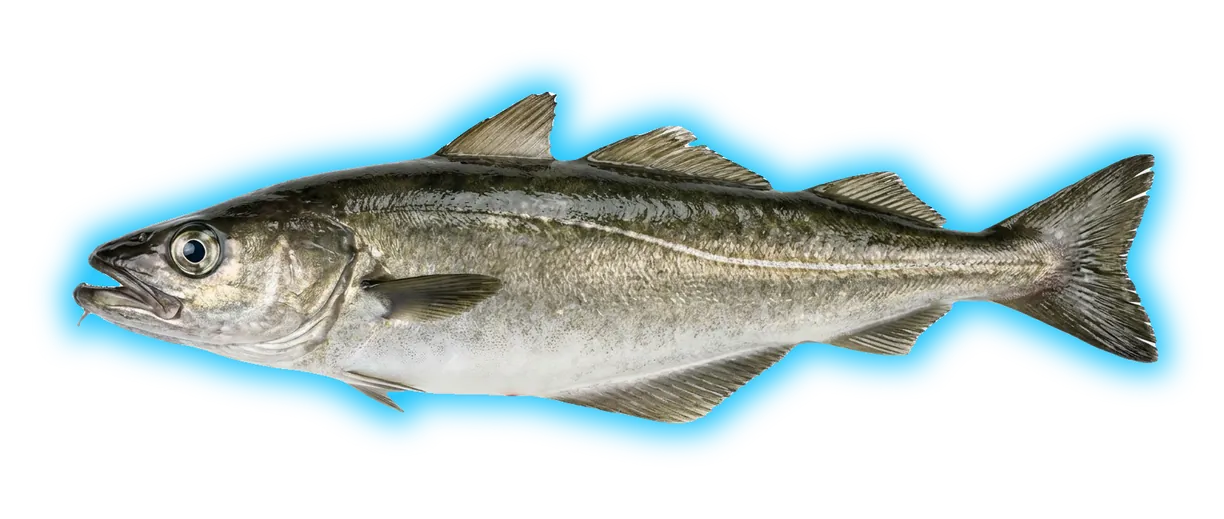
Pollock are streamlined, powerful swimmers with a distinctive greenish-bronze to dark grey back fading to a silvery belly. They possess a straight, pale lateral line running the length of their body, differentiating them from similar species like cod which have a curved lateral line. Their slender profile and deeply forked tail indicate their speed and predatory nature.
Source: FishBase & iNaturalist
Pollock Size & Bag Limits by State
Pollock rules in 6 states.
| State | Size limit | Daily bag | Season |
|---|---|---|---|
| MaineStatewide saltwaterYear-round | None | No limit | Year-round |
| MassachusettsStatewide saltwaterYear-round | None | No limit | Year-round |
| New JerseyStatewide saltwaterYear-round | 19" min | No limit | Year-round |
| New YorkStatewide saltwaterYear-round | 19" min | — | Year-round |
| Rhode IslandStatewide saltwaterYear-round | 19" min | — | Year-round |
| WashingtonMarine Area 10 - Seattle-Bremerton AreaYear-round · Closed to retention | None | 0 | Year-round · Closed to retention |
| Marine Area 11 - Tacoma-Vashon Island AreaYear-round · Closed to retention | None | 0 | Year-round · Closed to retention |
| Marine Area 12 - Hood CanalYear-round · Closed | None | 0 | Year-round · Closed |
| Marine Area 13 - South Puget SoundYear-round · Closed to retention | None | 0 | Year-round · Closed to retention |
| Marine Area 5 - Sekiu and Pillar PointYear-round | None | 2 | Year-round |
| Marine Area 6 - East Juan de Fuca StraitYear-round | None | 2 | Year-round |
| Marine Area 7 - San Juan IslandsYear-round | None | 2 | Year-round |
| Marine Area 8-1 - Deception Pass and Skagit BayYear-round · Closed to retention | None | 0 | Year-round · Closed to retention |
| Marine Area 8-2 - Port Susan and Port GardnerYear-round · Closed to retention | None | 0 | Year-round · Closed to retention |
| Marine Area 9 - Admiralty InletYear-round · Closed to retention | None | 0 | Year-round · Closed to retention |
— means the state sets no daily bag number for this species.
Statewide rules, or each area where a state sets limits by region. Many lakes and rivers have their own limits; pick a state or open its regulations page for water-specific rules. Always confirm with the state wildlife agency before keeping a fish.
Rules for a specific state
Pick a state to see its Pollock rules, including lakes and rivers with their own limits.
Select a state
Always confirm with the official state agency before keeping a fish.
Best bait and lures for Pollock
For these aggressive feeders, vertical jigging with heavy metal jigs or large soft plastics (like a curly tail grub on a jig head) is highly effective, especially when targeting schools on structure. Fast retrieves with spoons or artificial sand eels can also trigger strikes. Live or cut bait, such as mackerel chunks or strips, presented near the bottom or mid-water, works well.
Is Pollock good to eat?
★★★★★
Pollock offers a mild, slightly sweet flavor with a firm, flaky white flesh that holds up well to various cooking methods. It's a versatile and sustainable option, excellent baked, fried, or broiled, and is a popular choice for fish and chips.
Pollock habitat
This energetic species thrives in cooler North Atlantic waters, frequently inhabiting offshore banks, rocky reefs, and wrecks. They are often found in mid-water to near the bottom, preferring areas with strong currents and abundant prey. Coastal populations may move into shallower bays and estuaries during certain seasons.
Where Pollock are found
Pollock are widely distributed across the North Atlantic, ranging from the waters off Greenland and Norway down to the coast of New England in North America. They are also found around the UK, Iceland, and the Barents Sea.
Pollock behavior
As active pelagic predators, pollock often form large schools, aggressively pursuing baitfish such as mackerel, herring, and sand eels, along with crustaceans and squid. They are known for strong, drag-peeling runs once hooked and can be found feeding at various depths. Their movements can be seasonal, with some populations migrating closer to shore in warmer months.
Biggest Pollock
No catches logged yet for Pollock.
Be the first, download CatchVault and log your catch!
Tips & Tactics
Almaco Jack vs Amberjack: Greater, Lesser & Rudderfish ID
Almaco jack vs greater amberjack vs lesser amberjack vs banded rudderfish: eye stripe, fin lobes, spine counts, and why a wrong ID can break size limits.
Steelhead vs Rainbow Trout: Same Fish, Different Legal Rules
Steelhead and rainbow trout are the same species. How state laws define steelhead by length and water, the adipose fin rule, and how to tell them apart.
Channel vs Blue vs White vs Flathead Catfish: ID Guide
Tell channel, blue, white and flathead catfish apart by anal fin, tail and jaw, plus hardhead vs gafftop. Why the ID matters for limits and invasives.
Related Species
Where to Catch Pollock
States where Pollock is found, based on CatchVault's waterbody commonality data.
Think You Can Top the Leaderboard?
CatchVault is available on iPhone and Android. Download the app, log your Pollock catch, and see where you rank.