Almaco Jack vs Amberjack: Greater, Lesser & Rudderfish ID
Almaco jack vs greater amberjack vs lesser amberjack vs banded rudderfish: eye stripe, fin lobes, spine counts, and why a wrong ID can break size limits.
Four Jacks, One Look
Drop a jig on a Gulf oil rig or a South Atlantic wreck and there's a good chance a brown, torpedo-shaped jack with a dark stripe through its eye will grab it. Most anglers call every one of them an amberjack. In reality there are four closely related Seriola jacks out there, and they look alike enough that even trained survey crews mix them up.
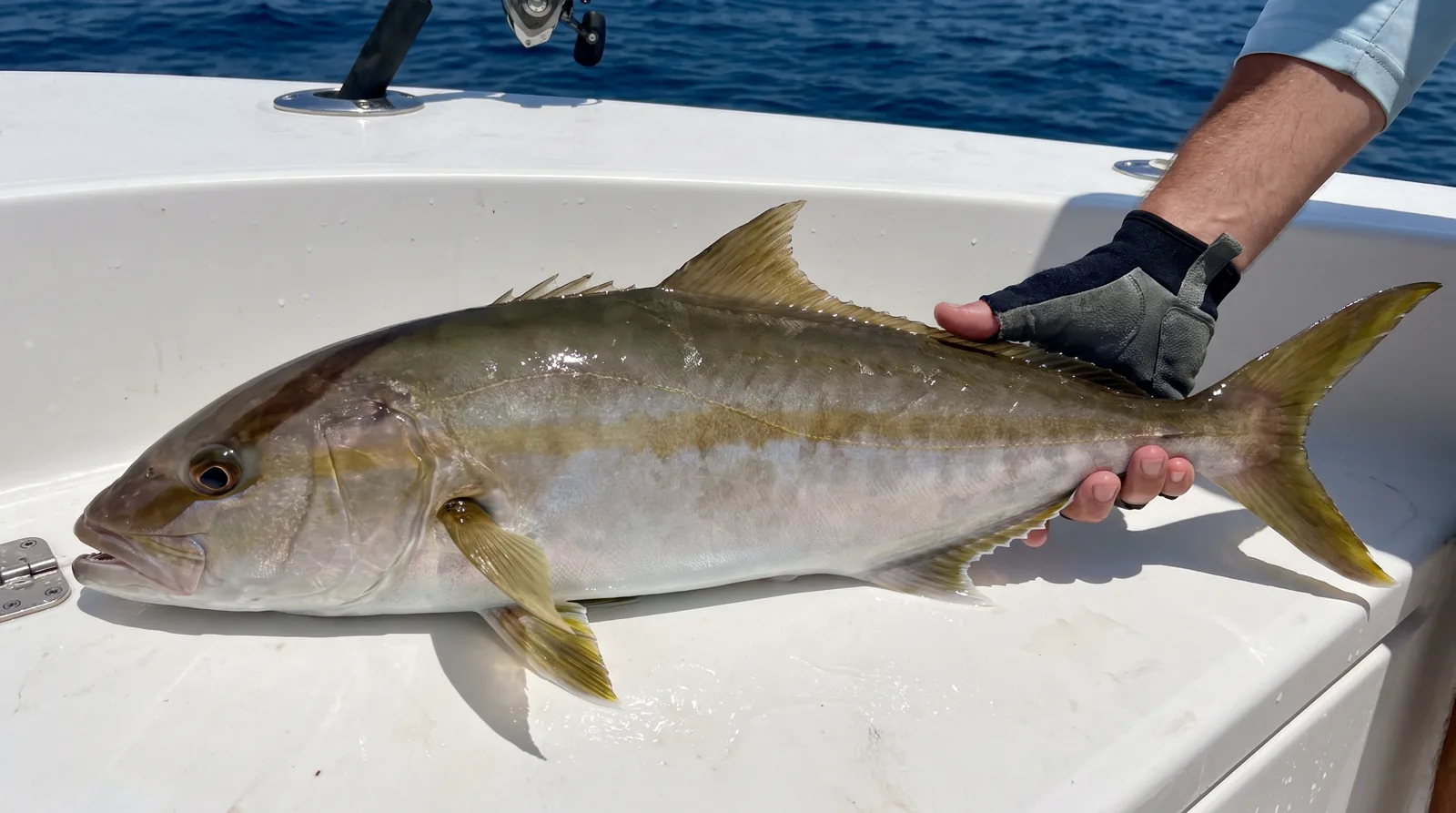
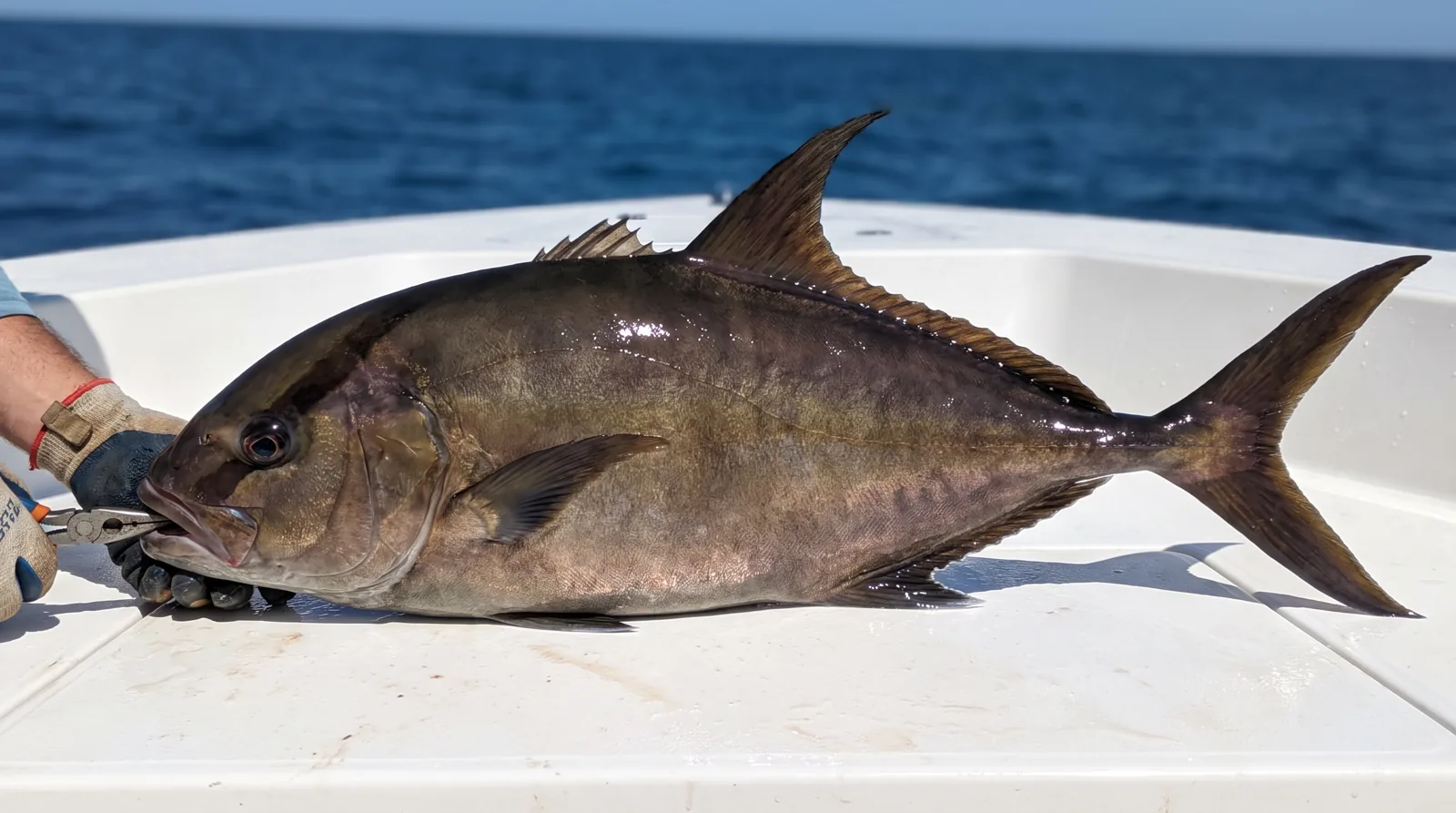
The four are the greater amberjack, the almaco jack, the lesser amberjack and the banded rudderfish. They share the same basic shape, similar colors, and a dark band that runs from the eye toward the dorsal fin. At 20 inches, any of the four can pass for the others at a glance.
Why It Matters
Greater amberjack carry the strictest rules of the four. The other three are managed together as a "jacks complex" with very different limits, so calling a fish by the wrong name can put an illegal fish in your cooler.
Here's how the rules looked when this was written:
- •Gulf federal waters: greater amberjack have a 34-inch fork length minimum, a one-fish daily bag, and a short season set each year. In 2026 the federal recreational season lasted only 43 days: it opened September 1 and closed after October 13. Lesser amberjack and banded rudderfish fall under a 14 to 22 inch fork length slot with a combined bag of five. Almaco jack have no minimum size and count toward the 20-fish reef fish aggregate.
- •South Atlantic federal waters: greater amberjack have a 28-inch fork length minimum, one fish per person, and are closed every April for spawning. Almaco jack, lesser amberjack and banded rudderfish have no federal recreational minimum size. They count toward a 20-fish snapper-grouper aggregate, with no more than 10 of any one species. The jacks complex has been shut down early in past years when catch limits were reached.
- •State waters: states set their own rules. Florida, for example, applies the 14 to 22 inch slot and five-fish combined bag to lesser amberjack and banded rudderfish on both coasts. It lists almaco jack as an unregulated species, which still carries the state's default limit of two fish or 100 pounds per person per day, whichever is more.
Now picture the classic mistake. In the Gulf you boat a 20-inch jack and decide it's a lesser amberjack, which fits the slot. If it's actually a young greater amberjack, you're holding a fish 14 inches under the minimum, and possibly out of season. On the Atlantic side, a 26-inch "almaco" that's really a greater amberjack is two inches short of legal. Limits change, sometimes mid-season, so check current federal and state rules before you keep anything. Our state regulations hub is a good place to start.
Quick Reference: Greater Amberjack vs Almaco Jack vs Lesser Amberjack vs Banded Rudderfish
| Feature | Greater Amberjack | Almaco Jack | Lesser Amberjack | Banded Rudderfish |
|---|---|---|---|---|
| Body shape | Long, fairly slender | Deep and flattened side to side | Moderately deep, with a big eye | Slim, the most slender of the four |
| Eye stripe (nuchal band) | Eye to the start of the first dorsal fin | Eye to the start of the first dorsal fin | Eye to the nape, stopping well before the dorsal fin | Eye to the start of the first dorsal fin |
| Second dorsal and anal fin lobes | Low | Tall and sickle-shaped | Short | Short |
| Anal fin vs second dorsal fin | Moderately short | Nearly as long as the second dorsal | Shorter than the second dorsal | About half the second dorsal |
| First dorsal spines | Usually 7 | Usually 7 | Usually 8 | Usually 8 |
| Tail | Plain | Plain | Plain | White or pale tips on the lobes |
| Maximum size | The giant: well over 100 lb on record | Can top 50 lb | Rarely much over 10 lb | Roughly 11 to 12 lb at most |
| Usual depth | Reefs, wrecks and rigs, often 60 to 240 ft | Offshore banks and outer reef slopes | Deeper shelf water | Shallower nearshore and shelf hard bottom |
Start With Size
Size settles most of the big ones. Mississippi State University's jack guide starts with one question: is it longer than three feet? If so, it's a greater amberjack. The one fish that can break that rule is a very large almaco jack, and its tall fins give it away. Greater amberjack are the largest of the group, with a maximum published weight around 177 pounds. Lesser amberjack and banded rudderfish top out around 10 to 12 pounds.
The trouble is the middle. Every legal-sized lesser amberjack or banded rudderfish overlaps in length with young greater amberjack, which is exactly where mistakes cost you. For anything under three feet, go through the checks below.
The Eye Stripe (Nuchal Band)
All four species can show a dark diagonal band running from the eye up and back across the head. Where it ends is one of the best field marks.
Lesser amberjack: the band ends at the nape, well in front of the first dorsal fin.
Greater amberjack, almaco jack and banded rudderfish: the band runs from the eye all the way back to the first dorsal fin.
The band isn't always visible and can fade with age, so use it as one clue, not the whole answer.
Fin Lobes and Body Depth: The Almaco Check
The almaco jack is the one with the tall fins. The front lobe of its second dorsal fin and its anal fin are long and sickle-shaped, and the anal fin is nearly as long as the second dorsal. Add a deep, flat-sided body and darker overall color, and the almaco is the easiest of the four to confirm.
In the FAO identification key for western Atlantic jacks, the almaco's dorsal lobe measures roughly a sixth to a quarter of its fork length, clearly longer than the lesser amberjack's. Greater amberjack have a low lobe on both fins.
Slender Body and White Tail Tips: The Rudderfish Check
Banded rudderfish are the slimmest of the four. Look for:
- •Pale or white tips on the tail lobes, which the other three lack. The tips can be faint, so don't rely on them alone.
- •A short anal fin, about half the length of the second dorsal fin's base
- •Bold, even bars in juveniles. Young rudderfish carry about six solid vertical bars that extend onto the dorsal and anal fins. Fish under about 11 inches also show the eye stripe strongly.
Rudderfish also tend to live shallower than the other species, over nearshore and shelf hard bottom.
Greater vs Lesser Amberjack: The Hardest Pair
Rule out the almaco and the rudderfish and you're left with the toughest call, and the one with the biggest legal stakes in the Gulf.
- •Eye stripe: the lesser's stops short of the dorsal fin; the greater's reaches it.
- •First dorsal spines: count the short spines in front of the soft dorsal fin. Greater amberjack usually have 7, lesser amberjack usually 8. In very large fish the front spines can become buried in skin, so count carefully.
- •Eye size and body depth: lesser amberjack have a proportionally larger eye and a slightly deeper body for their length.
- •Juvenile bars: very young greater amberjack have irregular, broken bars that stop on the body. Very young lesser amberjack have bars that extend onto the dorsal and anal fins. Both lose their bars by about 8 inches, so this only helps on fish far too small to keep.
- •Gill rakers: a lab-level check. On a fish over about 8 inches, greater amberjack have roughly 11 to 16 developed rakers on the first gill arch, while lesser amberjack have 21 to 28. It's the most clear-cut difference between the two, but you can only use it on a fish you've already kept.
Don't rely on size to sort these two. NOAA researchers recently confirmed lesser amberjack reaching about 30 inches fork length, longer than the previous published maximum. A lesser amberjack that big is above the Gulf slot and must go back anyway.
The Jaw and Head
The rear of the upper jaw differs slightly among the four. Scientific keys use the supramaxilla, a small bony plate that sits on top of the back end of the upper jaw. In adults it's broad with a rounded upper rear corner in greater amberjack, broad with a sharp corner in almaco jack, and more slender in lesser amberjack and banded rudderfish. The differences are subtle, which is why the Florida Fish and Wildlife Conservation Commission asks anglers submitting jack photos to include a close-up of the head that shows the upper jaw.
What to Do If You Catch One
If you're sure it's a greater amberjack: measure fork length, from the tip of the closed mouth to the fork of the tail, and check that the season is open where you're fishing. If it's short or the season is closed, release it quickly. Federal rules require a descending device on board when fishing for snapper-grouper species in the South Atlantic, and a descending device or venting tool rigged and ready when fishing for reef fish in the Gulf. A fish pulled from deep water has a better shot if you use one.
If you think it's a lesser amberjack or rudderfish: run the checks above before it goes in the box. In the Gulf, a 14 to 22 inch fish you can't confidently separate from a greater amberjack should be treated as a greater amberjack.
When in doubt, let it go. A released fish costs you nothing; a misidentified greater amberjack can cost you a ticket.
Take clear photos before you decide: one full side view showing the fins, and one close-up of the head. The CatchVault app can identify species from a photo and log the catch with its location, which gives you a record to double-check later.
Know Your Jacks
These four cousins share the same reefs and wrecks. Most of the time the eye stripe, the fin lobes, the tail tips and a quick spine count will sort them out. Learn those checks, photograph anything you're unsure about, and when it's close, give the benefit of the doubt to the greater amberjack.
Frequently Asked Questions
What's the difference between almaco jack and amberjack?
Almaco jack have a deeper, flatter body and much taller, sickle-shaped second dorsal and anal fins than greater amberjack. Their anal fin is nearly as long as the second dorsal fin, and they're usually darker overall.
How do you tell a lesser amberjack from a greater amberjack?
Check where the eye stripe ends. On a lesser amberjack it stops well in front of the first dorsal fin; on a greater amberjack it reaches the fin. Lesser amberjack also usually have 8 first dorsal spines to the greater's 7, and a proportionally bigger eye.
Can a lesser amberjack be longer than 22 inches?
Yes. NOAA researchers have documented lesser amberjack up to about 30 inches fork length. In the Gulf and in Florida state waters, any lesser amberjack over 22 inches is above the slot and has to be released.
Do greater amberjack have a size limit?
Yes, and it differs by region. When this was written, the federal recreational minimum was 34 inches fork length in the Gulf and 28 inches in the South Atlantic, with a one-fish bag in both. Check current federal and state rules before you fish.
Is an almaco jack a type of amberjack?
They're close relatives in the same genus, Seriola, but they're separate species. Almaco jack is Seriola rivoliana and greater amberjack is Seriola dumerili, and fishing rules treat them differently.
Ready to Fish Smarter?
Download CatchVault free on iPhone and Android. Log catches, identify species with AI, and measure your fish.