Channel vs Blue vs White vs Flathead Catfish: ID Guide
Tell channel, blue, white and flathead catfish apart by anal fin, tail and jaw, plus hardhead vs gafftop. Why the ID matters for limits and invasives.
Four Cats, One Cooler
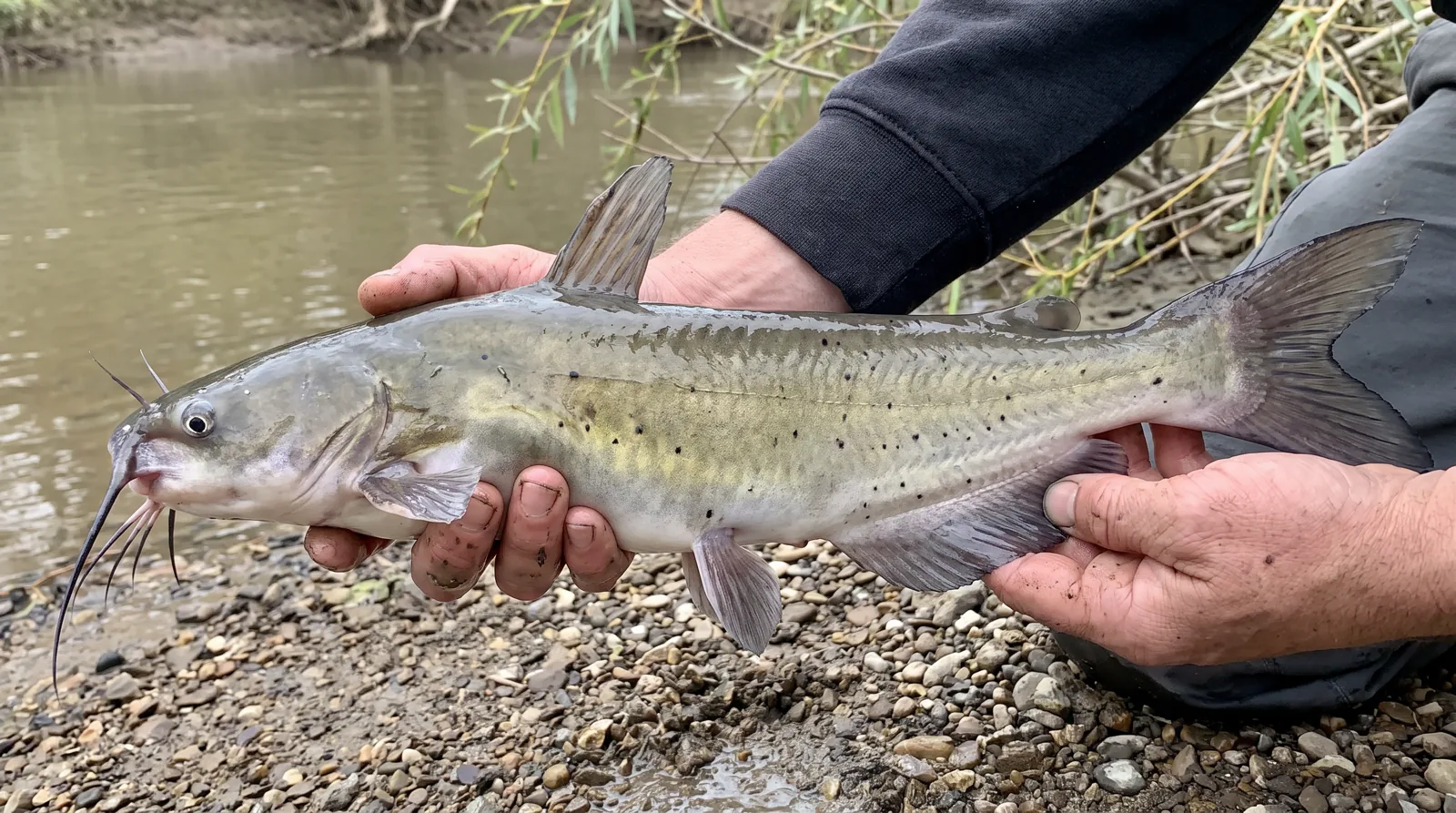
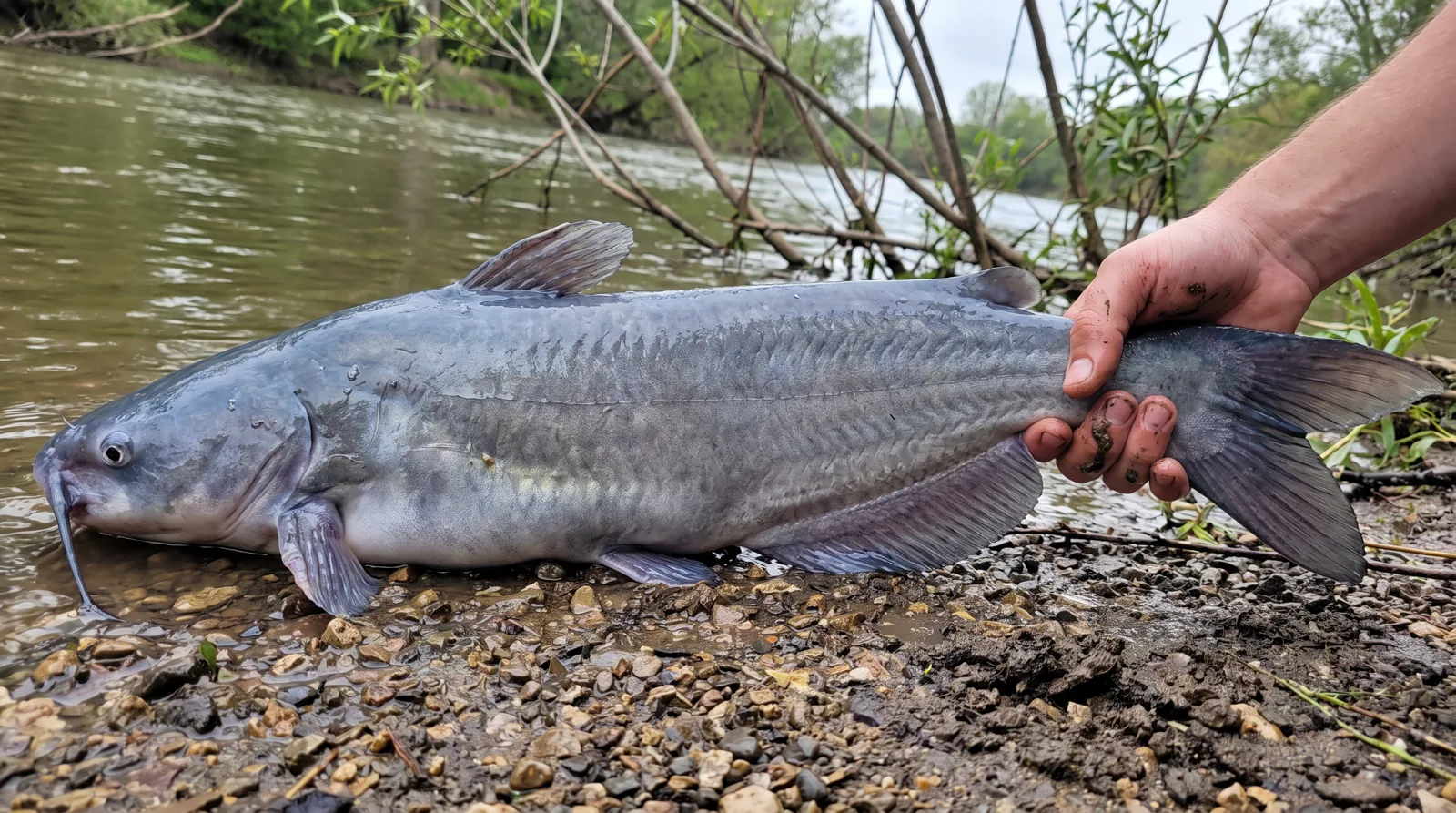
Pull a gray, forked-tail catfish out of a river and the boat usually splits into two camps: "that's a channel cat" and "no, that's a blue." Somebody else swears it's a white catfish. These are four different fish. Channel catfish, blue catfish, white catfish and flathead catfish overlap in a lot of water, and the young ones in particular look alike. A handful of features settle almost every argument, and you can check them all while you unhook the fish.
Why It Matters
In many states the rules treat these species differently, so a wrong ID can put you over a limit without realizing it.
- •Different daily limits. Missouri's 2026 statewide limits are 10 channel catfish, 5 blue catfish and 5 flathead catfish per day, with exceptions on waters that have special regulations. Keep six "channels" that are really blues and you're over.
- •Trophy protections. Some waters protect big blues specifically. In Virginia, Lake Gaston, Kerr Reservoir and part of the tidal James River allow only 1 blue catfish per day longer than 32 inches, while channel, white and flathead catfish don't fall under that rule.
- •Some states lump them. Texas combines channel and blue catfish into one 25-fish daily bag (only 10 can be 20 inches or longer), but flathead catfish have their own 5-fish bag and an 18-inch minimum. Here the channel-vs-blue call matters less than recognizing the flathead.
- •Invasive status. Blue catfish are native to the Mississippi, Missouri, Ohio and Rio Grande river basins, but they were stocked into Virginia's tidal rivers starting in the 1970s and have since spread to every Virginia tributary of the Chesapeake Bay. Virginia DWR lists them as invasive. Maryland DNR asks anglers to kill any blue catfish or flathead catfish they catch, discourages release, and makes it illegal to move either one alive into another body of water.
Limits change often and vary by lake and river, so always check current regulations for the water you're fishing before you keep anything.
Quick Reference: Channel vs Blue vs White vs Flathead
| Feature | Channel Catfish | Blue Catfish | White Catfish | Flathead Catfish |
|---|---|---|---|---|
| Tail | Deeply forked | Deeply forked | Moderately forked | Square or slightly notched |
| Anal fin edge | Rounded | Straight | Rounded | Short and rounded |
| Anal fin rays | About 24–29 | About 30–36 | About 18–25 | About 14–17 |
| Dark spots | Often, especially mid-size fish | Never | No | No (mottled instead) |
| Jaw | Upper jaw longer | Upper jaw longer | Upper jaw longer | Lower jaw sticks out past upper |
| Head | Moderate, gently sloped | Wedge-shaped, steep straight back profile | Wide head and mouth | Broad and very flat, small eyes on top |
| Chin barbels | Not a key feature | Not a key feature | White or pale | Not a key feature |
| Color | Olive brown or slate blue, silvery white belly | Pale bluish silver, silvery white belly | Blue-gray to blue-black back, sharply white belly | Pale yellow to brown, mottled |
| Common size | 12–32 in | 20–44 in | 10–18 in | 15–45 in |
Step One: Look at the Tail
Start with the tail because it sorts the four into groups instantly.
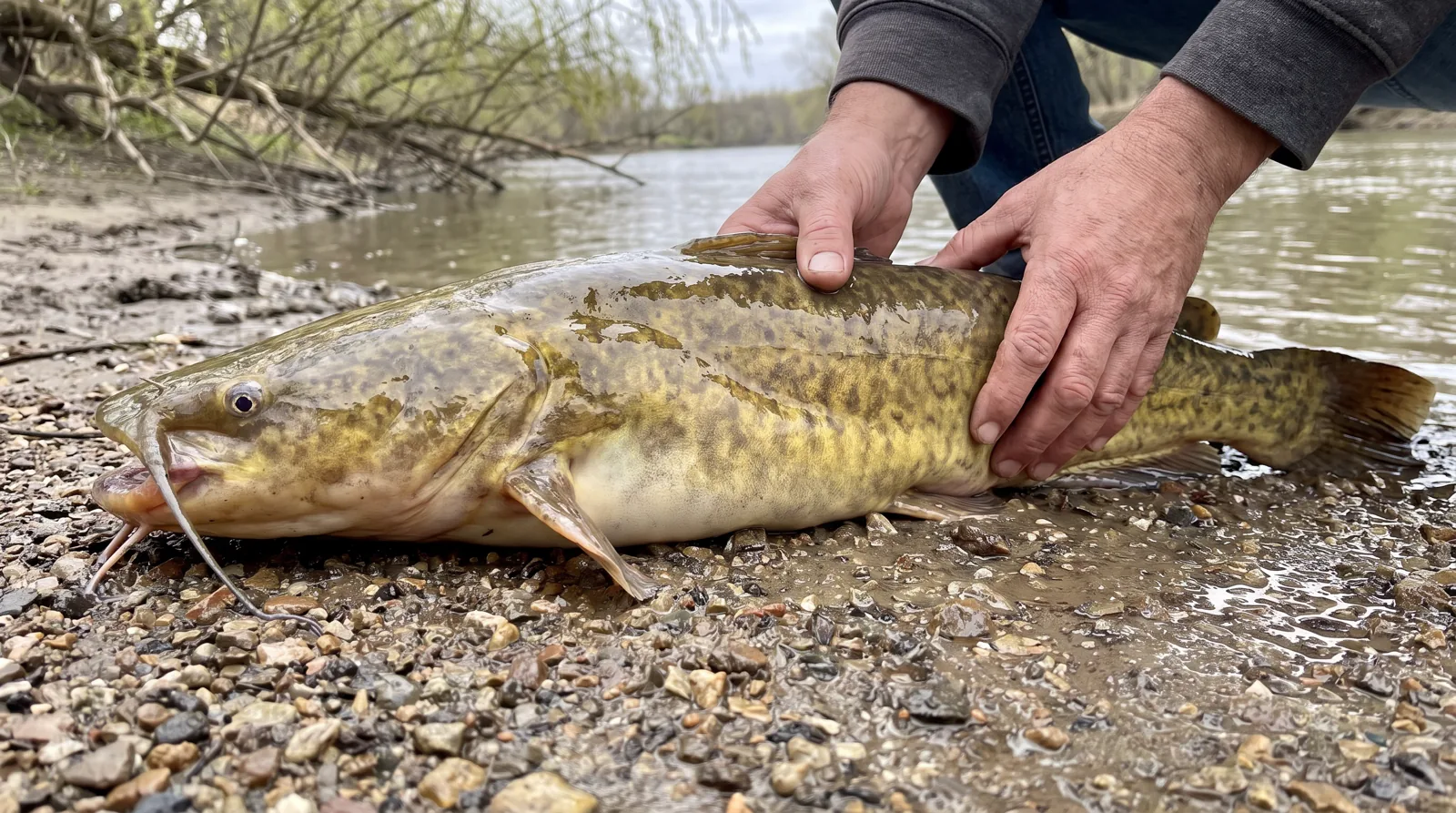
Flathead catfish have a tail that is nearly straight across or only slightly notched, never deeply forked. On younger fish the upper lobe often has a pale or whitish tip. If the tail is square, you're done; it's a flathead.
White catfish have a moderately forked tail. It's clearly forked, but the fork is noticeably shallower than on a channel or blue.
Channel and blue catfish both have deeply forked tails. The tail won't separate these two, so move on to the anal fin.
Step Two: The Anal Fin Settles Channel vs Blue
The anal fin is the long fin on the belly between the vent and the tail. It's the single most reliable way to tell a blue from a channel, and it works on fish of any size.
Blue catfish have a long anal fin with a straight outer edge. Lay the fish on its side and the bottom edge of that fin runs in a flat line, as if trimmed with a straightedge. It has about 30 to 36 rays.
Channel catfish have a shorter anal fin with a rounded outer edge that bulges outward in the middle. It has about 24 to 29 rays.
You don't need to count rays on a flopping fish; the shape is usually obvious. Counting is a tiebreaker for photos.
Spots: Helpful, but Not Proof
Channel catfish often have scattered dark spots on the back and sides. Blue catfish never have dark spots.
The catch is that spots aren't guaranteed. Small young channel cats and big adult channels can both lack them. So:
- •Spots present: it's not a blue.
- •No spots: could be either. Check the anal fin.
Head Shape and Body Profile
Blue catfish have a distinctive profile. From the dorsal fin forward, the back slopes steeply and in a fairly straight line down to the snout, which gives the head and front of the body a wedge shape. In some areas they're called "high-fin blues."
Channel catfish have a gentler, more rounded slope from the dorsal fin to the head. Breeding males turn blue-black and develop a swollen, knobby head with thick lips, which throws people off.
White catfish have a wider head and mouth than a channel catfish of the same length, and their chin barbels are white or pale.
Flathead catfish have a broad, flattened head with small eyes set on top. The lower jaw projects well beyond the upper jaw, so the fish has a bulldog underbite. Channel, blue and white catfish are the opposite: their upper jaw extends past the lower.
White Catfish vs Channel Catfish
This pair gets mixed up a lot on the East Coast. White catfish are native to Atlantic and Gulf slope rivers from the lower Hudson south into Florida, where they often share water with channel catfish.
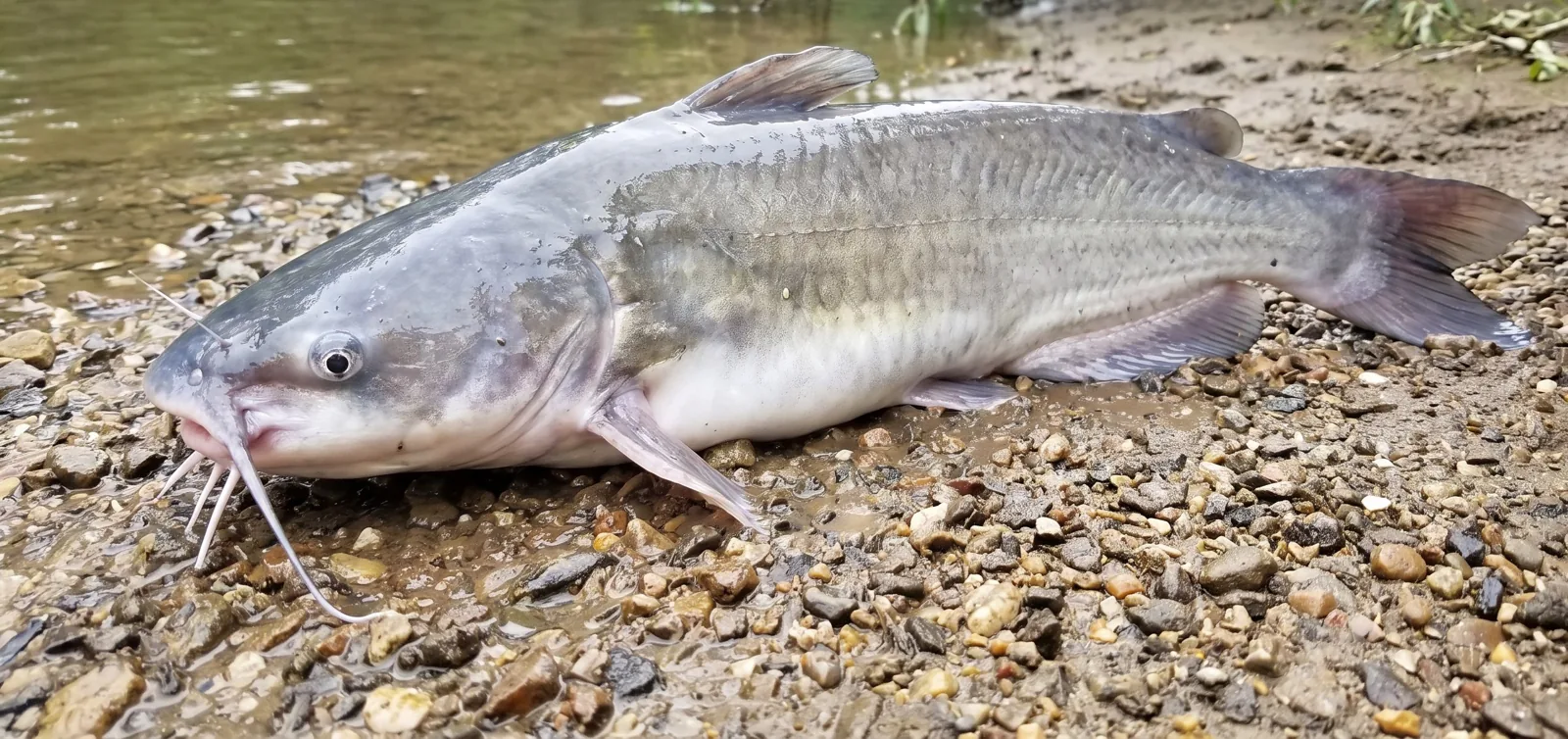
Check these in order:
- •Tail. White catfish have a moderate fork. Channels have a deep fork.
- •Anal fin. White catfish have a shorter anal fin with fewer rays. Published counts run from 18 to 25, against 24 to 29 for a channel, so the counts can overlap at the edges. Use it with the tail and spots, not alone.
- •Spots. White catfish don't have the dark spots many channels carry.
- •Color. White catfish are often sharply two-toned: a blue-gray back with a clear line where it meets a white belly.
- •Chin barbels. Pale or white.
- •Size. White catfish usually run 10 to 18 inches and top out around 24 inches. Connecticut's fisheries agency notes that most angler-reported "white catfish" over 10 pounds were probably misidentified channel catfish.
Flathead Catfish: The Easy One
Once you've seen a flathead you won't forget it. Square tail, flat head, underbite, and mottled yellow to brown coloring. They also have a short, rounded anal fin with fewer than 18 rays. Depending on where you fish, you'll also hear them called yellow cats or Opelousas cats.
Saltwater: Hardhead Catfish vs Gafftopsail Catfish
Along the Gulf and Atlantic coasts, the two catfish you'll catch in bays and surf are the hardhead catfish and the gafftopsail catfish, often just called gafftop. Both have deeply forked tails, and unlike freshwater catfish, neither has barbels by the nostrils. They're easy to separate.
Gafftopsail catfish:
- •Long filaments. The spines at the front of the dorsal fin and each pectoral fin end in long, fleshy filaments that trail behind like streamers. That "sail" is where the name comes from.
- •Four barbels. Two on the chin, plus two very long, flattened barbels at the corners of the mouth.
- •Color. Bluish-green on the back, fading to a silvery white belly.
Hardhead catfish:
- •No filaments. The dorsal and pectoral spines are sharp but plain.
- •Six barbels. Four on the chin and two at the corners of the mouth. The mouth-corner barbels are short, round and nowhere near as long as a gafftop's.
- •Color. Brownish to gray-green on top with a whitish or yellowish belly.
- •Size. Usually small. Texas Parks and Wildlife puts the average at about 10 inches and half a pound.
Quick test: streamers and long flat whiskers mean gafftop. No streamers and four short chin whiskers mean hardhead.
In both species the male carries the eggs in his mouth until they hatch, so don't be surprised to find a mouthful of eggs.
Handle the Saltwater Cats Carefully
Both saltwater species carry three sharp spines, one at the front of the dorsal fin and one in each pectoral fin. The hardhead's dorsal spine is barbed and covered in a mildly toxic slime, and the gafftop's dorsal and pectoral spines are also venomous. A puncture causes severe pain and swelling.
- •Use pliers or a dehooker, not your hands.
- •Never step on one on the deck or beach, even a dead one.
- •Clean any puncture well and get medical care if pain, swelling or redness keeps getting worse.
If You're Not Sure
Take a few photos before you release or keep the fish: the full side with the anal fin spread, the tail, and the head from the side to show the jaw. Those three shots will settle almost any channel, blue, white or flathead question. The CatchVault app can identify the species from a photo and log the catch with the location, which is handy when you're keeping a count against different limits for each species.
Frequently Asked Questions
How do you tell a blue catfish from a channel catfish?
Look at the anal fin. A blue catfish's anal fin has a straight outer edge and about 30 to 36 rays. A channel catfish's anal fin is rounded and has about 24 to 29 rays. Dark spots mean channel, but a channel without spots is common.
Do blue catfish have spots?
No. Blue catfish never have dark spots. Among these four catfish, a spotted fish with a deeply forked tail is a channel catfish, though many channels have no spots.
What is the difference between white catfish and channel catfish?
White catfish have a moderately forked tail, a shorter anal fin, no dark spots, pale chin barbels and a wider head. They rarely grow past about 24 inches. Channel catfish have a deeply forked tail and often have dark spots.
How can you tell a flathead catfish?
A square or slightly notched tail, a broad flat head, and a lower jaw that sticks out past the upper jaw. No other common catfish has all three.
What's the difference between a hardhead and a gafftop?
Gafftops have long fleshy filaments on the dorsal and pectoral spines and four barbels, including two long flat ones at the mouth corners. Hardheads have no filaments and six barbels, four of them on the chin.
Are hardhead and gafftop catfish venomous?
Yes, enough to hurt. The gafftop's spines are venomous and the hardhead's barbed dorsal spine carries a mildly toxic slime, so a puncture causes severe pain and swelling. Handle both with pliers and never step on one.
Are blue catfish invasive?
In the Chesapeake Bay region, yes. Virginia lists blue catfish as invasive, and Maryland asks anglers to kill any blue catfish they catch. They're native to the Mississippi, Missouri, Ohio and Rio Grande river basins, where they're a managed sport fish, so check your state's rules.
Ready to Fish Smarter?
Download CatchVault free on iPhone and Android. Log catches, identify species with AI, and measure your fish.