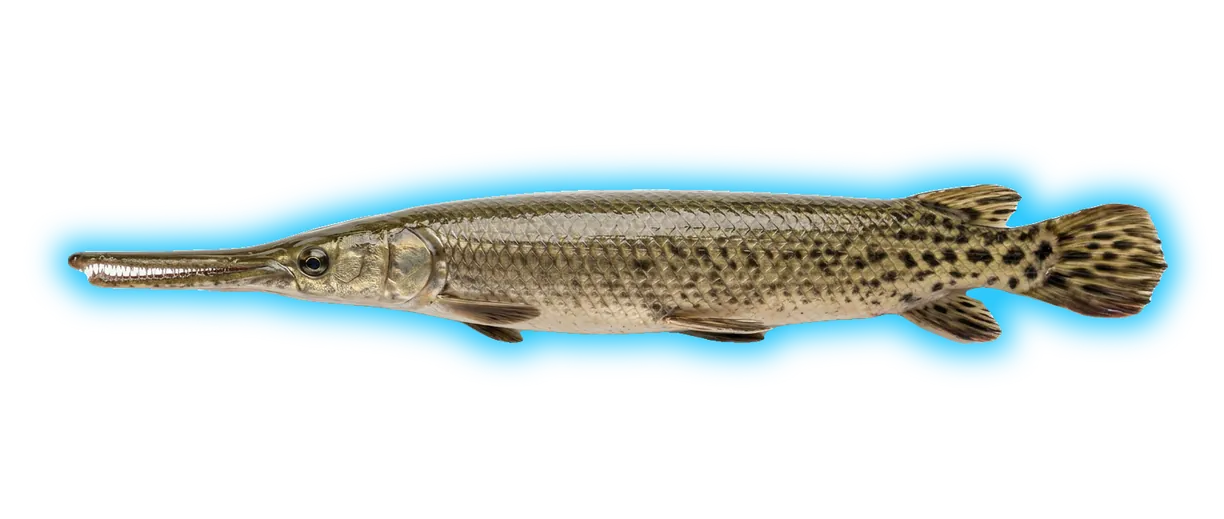
Also known as
Needlenose Gar, Billfish, Long-nosed Gar, Billy Gar
IUCN status
Least ConcernAbout the Longnose Gar
The Longnose Gar is an ancient and distinctive predator, easily identified by its exceptionally long, slender snout filled with needle-sharp teeth. Its torpedo-shaped body is covered in tough, ganoid scales, offering armor-like protection. Typically olive to brown on the back, fading to a lighter belly, they can reach impressive lengths, often appearing like living fossils.
Source: FishBase & iNaturalist
Longnose Gar Size & Bag Limits by State
Longnose Gar rules in 5 states.
| State | Size limit | Daily bag | Season |
|---|---|---|---|
| IllinoisMississippi River (IL/MO portion)Year-round | None | 100 | Year-round |
| Mississippi River — BETWEEN IL & MOYear-round | None | 100 | Year-round |
| LouisianaYear-round | None | No limit | Year-round |
| MinnesotaYear-round | None | 10 | Year-round |
| MissouriYear-round | None | 50 | Year-round |
| VirginiaJul 1 – Apr 14, Apr 15 – Jun 30 | None | 5 | Jul 1 – Apr 14, Apr 15 – Jun 30 |
Statewide rules, or each area where a state sets limits by region. Many lakes and rivers have their own limits; pick a state or open its regulations page for water-specific rules. Always confirm with the state wildlife agency before keeping a fish.
Rules for a specific state
Pick a state to see its Longnose Gar rules, including lakes and rivers with their own limits.
Select a state
Always confirm with the official state agency before keeping a fish.
Best bait and lures for Longnose Gar
Gar are attracted to live baits like shiners or small sunfish, fished under a float or free-lined. Artificial lures like spoons, spinnerbaits, or soft plastics can also provoke strikes, especially when retrieved slowly. A common and effective method is using a fraying nylon rope lure, which entangles their needle-like teeth without requiring a hook, preventing swallowed hooks and aiding release.
Is Longnose Gar good to eat?
★★★★★
While often overlooked, the white, flaky meat of the Longnose Gar is surprisingly good, often compared to cod or chicken, though cleaning them can be a significant challenge due to their incredibly tough, armored scales. A critical warning: gar eggs are highly toxic and should never be consumed.
Longnose Gar habitat
These fascinating fish prefer slow-moving freshwater environments, commonly found in large rivers, backwaters, oxbow lakes, and reservoirs. They often lurk among submerged vegetation, fallen timber, or other structure where they can ambush prey.
Where Longnose Gar are found
Longnose Gar are distributed along the East Coast of North and Central America, extending westward into states like Kansas, Texas, and southern New Mexico.
Longnose Gar behavior
Primarily ambush predators, Longnose Gar patiently wait for unsuspecting fish or crustaceans to pass by, then strike with a swift sideways snap of their powerful jaws. They are often seen basking near the surface in warm weather, appearing lethargic, but can explode with surprising speed when feeding or startled. Their activity tends to increase during dawn and dusk.
Biggest Longnose Gar
No catches logged yet for Longnose Gar.
Be the first, download CatchVault and log your catch!
Tips & Tactics
Steelhead vs Rainbow Trout: Same Fish, Different Legal Rules
Steelhead and rainbow trout are the same species. How state laws define steelhead by length and water, the adipose fin rule, and how to tell them apart.
Channel vs Blue vs White vs Flathead Catfish: ID Guide
Tell channel, blue, white and flathead catfish apart by anal fin, tail and jaw, plus hardhead vs gafftop. Why the ID matters for limits and invasives.
Alewife vs Blueback Herring: River Herring & Shad ID Guide
How to tell alewife from blueback herring, and both from American, hickory and gizzard shad, plus why river herring harvest is closed in many states.
Related Species
Where to Catch Longnose Gar
States where Longnose Gar is found, based on CatchVault's waterbody commonality data.
Think You Can Top the Leaderboard?
CatchVault is available on iPhone and Android. Download the app, log your Longnose Gar catch, and see where you rank.