Water Type
Freshwater
Also known as
Eel-pout, Lawyer, Freshwater Cod, Cusk
IUCN status
Least ConcernAbout the Burbot
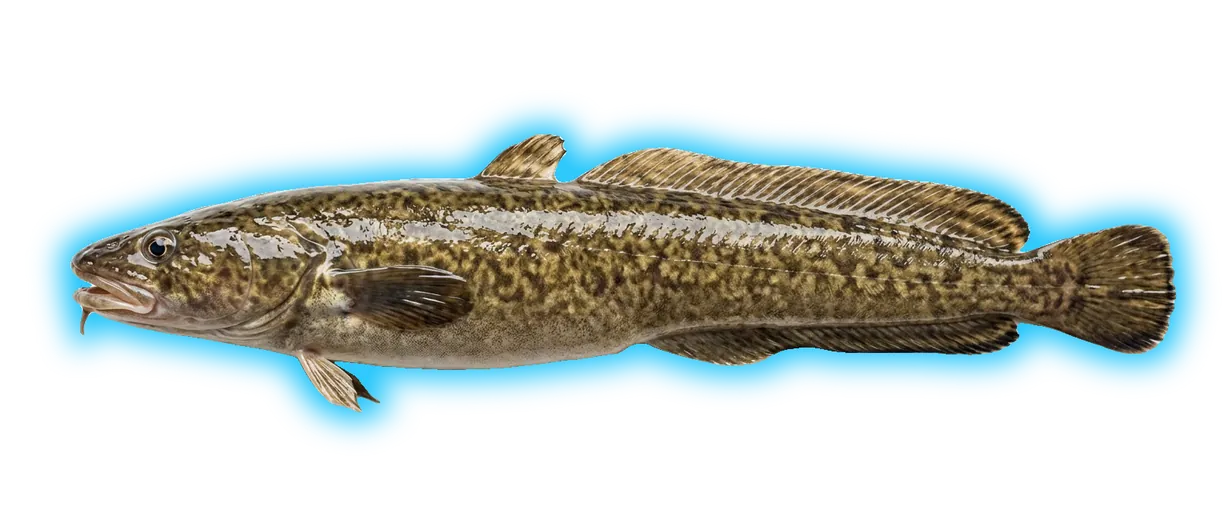
The Burbot is an unmistakable freshwater fish, often described as a cross between a catfish and an eel, or even a snake. It possesses a long, slender, olive-brown body, typically mottled with darker brown or black markings, fading to a lighter belly. A single, prominent barbel hangs from its chin, distinguishing it from most other freshwater species. Its small scales give it a smooth, slimy feel, while its two dorsal fins and long anal fin run nearly the length of its body.
Source: FishBase & iNaturalist
Burbot Size & Bag Limits by State
Burbot rules in 13 states.
| State | Size limit | Daily bag | Season |
|---|---|---|---|
| ConnecticutYear-round · Year-round closed | None | 0 | Year-round · Year-round closed |
| IdahoPanhandle RegionYear-round | None | 6 | Year-round |
| MassachusettsYear-round · Year-round closed | None | Catch & release | Year-round · Year-round closed |
| MichiganYear-round | None | 5 | Year-round |
| MinnesotaYear-round | None | 4 | Year-round |
| MontanaBighorn LakeYear-round | None | 3 | Year-round |
| Central Fishing DistrictYear-round | None | 5 | Year-round |
| Clark Canyon ReservoirYear-round | 23" min | 3 | Year-round |
| Eastern Fishing DistrictYear-round | None | 5 | Year-round |
| Fort Peck Reservation Boundary Waters (Big Muddy Creek, Missouri River, Milk River)Year-round | None | 5 | Year-round |
| LAKE SUTHERLIN — Including inlet areas on state landYear-round | None | 3 | Year-round |
| NEWLAN CREEK RESERVOIR — Including a 400-yard reach of inlet stream from the mouth up to a concrete water weirYear-round | None | 3 | Year-round |
| Western Fishing DistrictYear-round | None | 2 | Year-round |
| New HampshireYear-round | None | No limit | Year-round |
| North DakotaYear-round | None | 10 | Year-round |
| PennsylvaniaLake Erie and TributariesYear-round, Jun 1 – Sep 30 | None | 5 | Year-round, Jun 1 – Sep 30 |
| UtahYear-round | None | No limit | Year-round |
| WashingtonYear-round · Lakes, ponds & reservoirs: year-round | None | 5 | Year-round · Lakes, ponds & reservoirs: year-round |
| WisconsinYear-round | None | No limit | Year-round |
| WyomingYear-round | None | 3 | Year-round |
Statewide rules, or each area where a state sets limits by region. Many lakes and rivers have their own limits; pick a state or open its regulations page for water-specific rules. Always confirm with the state wildlife agency before keeping a fish.
Rules for a specific state
Pick a state to see its Burbot rules, including lakes and rivers with their own limits.
Select a state
Always confirm with the official state agency before keeping a fish.
Best bait and lures for Burbot
Targeting Burbot is most effective after dark or during winter ice fishing. Glow-in-the-dark jigging spoons, often tipped with a piece of cut bait like sucker or minnow, are highly effective when fished directly on the bottom. Dead bait presentations, such as a whole or cut minnow on a hook fished off a three-way swivel or a slip sinker rig, are also excellent choices. Look for them in deep holes, along transition lines, or near rocky points.
Is Burbot good to eat?
★★★★★
Often hailed as "poor man's lobster," Burbot offer superb table fare. Their firm, white, flaky meat has a delicate, sweet flavor, especially when boiled or steamed and served with butter. It's truly a hidden culinary gem among freshwater fish.
Burbot habitat
Burbot are cold-water specialists, preferring the deep, oxygen-rich waters of large lakes and rivers. They are typically found near the bottom, often around rocky structures, shoals, or areas with sand and gravel substrates. During the warmer months, they retreat to the deepest, coolest parts of their habitat.
Where Burbot are found
This unique fish boasts a circumpolar distribution, found across the northern latitudes of North America, Europe, and Asia. In North America, their range extends from Alaska and Canada south into the northern United States, particularly in the Great Lakes region and various northern river systems.
Burbot behavior
Primarily nocturnal predators, Burbot are most active at night or during periods of low light, especially when foraging. They are opportunistic bottom-feeders, consuming a diet of aquatic insects, crustaceans, and other fish, including sculpins, perch, and even smaller Burbot. During winter, Burbot become particularly active, feeding aggressively and undertaking spawning migrations under the ice, making them a prime target for ice anglers.
Biggest Burbot
No catches logged yet for Burbot.
Be the first, download CatchVault and log your catch!
Tips & Tactics
Steelhead vs Rainbow Trout: Same Fish, Different Legal Rules
Steelhead and rainbow trout are the same species. How state laws define steelhead by length and water, the adipose fin rule, and how to tell them apart.
Channel vs Blue vs White vs Flathead Catfish: ID Guide
Tell channel, blue, white and flathead catfish apart by anal fin, tail and jaw, plus hardhead vs gafftop. Why the ID matters for limits and invasives.
Alewife vs Blueback Herring: River Herring & Shad ID Guide
How to tell alewife from blueback herring, and both from American, hickory and gizzard shad, plus why river herring harvest is closed in many states.
Related Species
Where to Catch Burbot
States where Burbot is found, based on CatchVault's waterbody commonality data.
Think You Can Top the Leaderboard?
CatchVault is available on iPhone and Android. Download the app, log your Burbot catch, and see where you rank.